General
Tobarra is a town located in Castilla la Mancha, more specifically, in the province ofrovince of Albacete, a 50 kilometres from the capital. It has a population of over 7,000 inhabitants, distributed between the municipality of Tobarra itself and half a dozen districts (Aljubé, Cordovilla, Los Mardos, Mora de Santa Quiteria, Santiago de Mora and Sierra). It is excellently communicated as it is crossed by both both on the A-30 motorway and on the A-30. N-301 road, both heading directly to the north and south of the peninsula. The population is spread around the Santa Barbara Hilla (also called the Clock), flanked by two other emblematic hills: on of the Incarnation and the of Calvary.
Its climate is considerably arid, which The fact that there is no river nearby means that the natural landscape is made up of low scrubland and not very extensive pinewoods. Nevertheless, in the midst of all this dry environment, we can enjoy the Alboraj Lagoon, of karstic origin and declared a Microreserve in 2000, and home to peculiar species such as the Leper tortoise, the Brown nightjar o the native and endangered plant Helicantherrium polygonoides.
Tobarra is twinned with the Teruel village of Híjar, It shares with it, among other things and relevant historical facts, the important drumming tradition that we will talk about later on.
History
Tobarra's origins date back to prehistoric times, as fragments of flint and arrows from the Palaeolithic period have been found in the area of Polope, as well as some Neolithic pottery. It is also worth mentioning the remains of an Iberian necropolis from the 6th century BC located in the Hoya de Santa Ana.
The origin of the name is not known for sure, but it was first mentioned by the geographer Al-Udri in the 11th century. One hypothesis holds that the origin is Iberian (the phonetics is Iberian), and another that it is Roman (“Túrbula la Romana”, as the local hymn says), on the basis of a map by Ptolemy which shows a Turbula in a location similar to the location actto that of the municipality, but which can be confused with the city of Villena (Alicante). In any case, Romans, Visigoths, Muslims and the Kingdom of Castile have left important traces (although not very numerous and most of them in poor condition) in the village.
The proof that Tobarra was inhabited after the Roman conquest of the Iberian Peninsula is the road that connected Complutum (Alcalá de Henares) with Carthago Nova (Cartagena), which passed through Tobarra and, after a slight detour, then resumed its journey to Illunum (Minateda).
With regard to the visigodos, we have one of the most important archaeological remains in the province of Albacete: the Hispano-Visigothic Hermitage The 6th-century site is located in La Muela, between Aljubé and the Laguna de Alboraj. It was built near an old Roman quarry, excavated directly into the mountain, and served as a meeting place and place of worship for a considerable but as yet undetermined period of time. There are those who believe that the settlement is of Etruscan origin.
In the Muslim era Tubarra (as it is called) was part of the Kura of Todmir (a former province ruled by the Visigothic nobleman Theodomyrus, the signatory of the famous pact that bears his name). St is known that two fortresses and a mosque (on top of which a hermitage was later built) were built, as well as an extensive network of irrigation systems that turned the site into a a veritable orchard of which some original wells were te still continue to running. Several place names also originate from this period, such as Aljubé, Alborajico, Abenuj or Alboraj. It is worth noting that in Tobarra there was a local warlord from the Andalusian period who was called Yagub ibn Khalid, Al Tubarri, meaning Khalid The one in Tobarra.
In 1243, the town was reconquered by the prince Alfonso of Castile (future King Alfonso X the Wise). Shortly afterwards it belonged to the alfoz of Alcaraz.. In the 14th and 15th centuries it alternated between being a manorial town - the various owners of the Marquisate of Villena - and a royal town under the Castilian kings. In 1324 the town was burnt down and completely razed to the ground by Nasrid raids, to the point that it had to be rebuilt. In 1476 is definitively incorporated into the Crown of Castile with the Catholic Monarchs.
Finally, a couple of curious notes: In 1766, after Madrid, Tobarra became the second place in Spain to rise up in the face of the serious crisis it was experiencing. the nationin the context of the Esquilache Mutiny. (PTo make matters worse, the Marquis of Esquilachehad slept in Tobarra the night before while he was immersed in his exile). In the elaboration of the Constitution of 1812 intervened the priest from Tobarra Ramón de los Santos García Pérez, who had written a book in 1805 entitled Theory of a Political Constitution for Spain.
Monuments
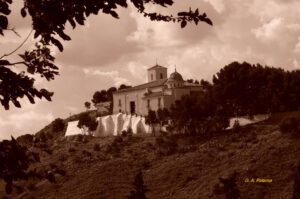 The Sanctuary of Nuestra Señora de la Encarnación and Cristo de la Antigua Hermitage, The building was declared a National Historic and Artistic Monument in 1981, where we can find a Mudejar coffered ceiling of great value, frescoes from the 15th century.I which depict the Passion and the patron saints, a dressing room with 17th century mural paintingsI dedicated to the Virgin Mary, which has recently been restored, and another rococo chapel in the chapel where the Christ of Antigua, the patron saint of the town. It is located near another singular enclave: The Devil's Eyes, which is actually a part of the wreckage of aa tower of the This ancient medieval castle was formerly a Muslim fortress, of which, in addition to this section, there are also remains of the central tower, the gate and a cistern that is still functional.
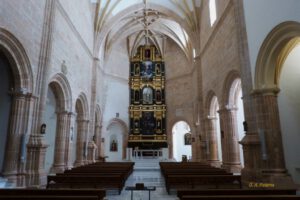 The Church of Our Lady of the Assumption, built between 1546 and 1616, one of the most outstanding examples of the Renaissance style in the region (although it has a Gothic floor plan). It suffered a collapse in the first half of the 20th century, in which the bell tower collapsed and caused significant damage to the entire structure. Since then there have been numerous reconstructions, the last one quite recently. It was declared an Asset of Cultural Interest in 2000. It houses most of the images that are paraded during Holy Week.
The Drum Museum located in which outside Hermitage of La Purísima (17th century). This museum is unique in Europe and houses drums from the five continents, as well as other percussion pieces and a lot of information related to the Tobarreña drumming tradition, its history and craftsmanship.
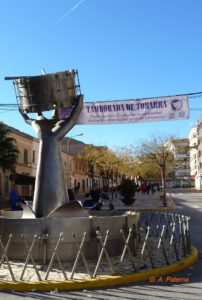 Drum Monument and Monument to the Nazarene, Both are the work of local artist Jesús D. Jiménez Ramírez, and pay tribute to the two essential pillars of the most important week in this municipality in La Mancha. The first one represents the drum and its evolution (the real name is Evolution), and brings together hundreds of drummers, if not thousands, to enjoy the "Cierre del Tambor" in unison. The second, for its parte, pays tribute to Nazarenes and grips, The tradition is passed on from generation to generation.
We can also find the Town Clock; the Church of San Antón; the Calvari Chapelo and the stops of the Stations of the Cross which is located at its entrance; the Convent of the Franciscan Observants of Saint Joseph (currently Federation headquarters de Cofradías de Semana Santa); the previously mentioned Rupes HermitageHispano-Visigothic of Alborajico and the tower of El Castellar in Sierra, the other Muslim stronghold of the qere are identifiable remains: a tower in fairly good condition.
Gastronomy
The gastronomy of Tobarreña offers more or less typical dishes of La Mancha cuisine, such as gazpachos or rice with rabbit and snails, “ajo de mataero”, gachas, migas ruleras, atascaburras or rabbit with garlic; desserts such as Pan de Calatrava, fritillas, panecicos, etc. sweets or tortas de manteca and toñas; appetizers such as forro, tripe, tripe, tripe, michirones (tripe with tripe) or snails. As for the latter, they are a much appreciated and consumed summer dish, and each bar or restaurant prepares them with their own personal touch. This is why there are as many recipes for snails as there are bars that offer them.
Tobarra also produces great wines (Designation of Origin Jumilla) and delicious and varied sausages, as well as game preserves. And there is also an enormous variety of agricultural products, among which the following stand out saffron, broad beans (apart of a variety of recipes, they are often eaten raw when fresh) and the Moniquí“ apricot”, which is highly appreciated and has national and even international fame. It is a variety that comes from the East (like all apricots), but in the lands of Tobarra it has found the ideal place to thrive and delight the palates and stomachs of foodies. Despite having a very short flowering period and being very demanding in terms of optimum conditions for pollination and production, the extraordinary flavour and size of this product more than compensates for these constraints.
Festivities
Its most important festivities and celebrations are the Easter, declared to be of Regional and National Tourist Interest, with its famous Drumming (104 hours) and their solemn processions, the May Festivities, in honour of their patron saints on Christ of Antigua and Our Lady of the Incarnation and the San Roque Fair and Festivities which is celebrated from 14th to 21st August. The most important of these is undoubtedly Easter Week.
Easter Week, declared of Regional and National Tourist Interest, has an uncertain origin, but probably has something to do with the arrival of San Vicente Ferrer to preach in the town in 1411. The first brotherhood of which there is any evidence is that of the Blood of Christ, It was already in existence in the 16th century and only took part in processions on Good Friday. In the following decades, other brotherhoods and floats were integrated, and at the end of the 18th century, the image of the Virgin Mary was added to the procession. Our Lady of Sorrows, by the famous sculptor Francisco Salzillo, It is surely the most prestigious piece of sculpture in Tobarra.
In the Civil War, during the summer of 1936, it was destroyed almost all of Tobarre's heritage related to the Semanto Santa. Only the heads survived from the image of the Our Lady of Sorrows and the from Ecce Homo and a handful more remains of other images, banners and thrones. Almost everything had to be rebuilt and restored. Guilds and families are the backbone of the brotherhoods of Tobarra, so much so that for a long time it has been normal for families and/or guilds to take charge of the organisation and expenses of the processions in some cases.
Currently in Tobarra there are 15 brotherhoods processions throughout the week, from the beginning of the week to the end of the week. Easter Monday until Easter Sunday, with the exception of Holy Saturday (not todas every day, ifnot that there is programming based on the Passion of Christ). Although it could be said that the feast really begins on Palm Sunday with the Procession of the Palms, in which the people of Tobarre take out a “La Burrica”, symbolising the arrival of Jesus in Jerusalem. In the processions, the steps -carried on the shoulders and their brothers and sisters are accompanied by musical bands, and some brotherhoods even have their own band. This helps to give these events that solemn, mystical and exciting touch.
Drum
One hypothesis, which is very difficult to prove, suggests that it was the Berbers those who introduced the drum in Tobarra at the time of the Al-Andalus, but there is as yet no evidence to prove it. Another hypothesis claims that it could have been an element incorporated into the procession at some point from the 16th century onwards by the Franciscans or by the brothers of the Brotherhood of the Blood, separating aftertion of the processions (19th century), or even with the arrival of St. Vincent Ferrer, in the processions organised byaba this priest, who was said to be “accompanied by all kinds of instruments and gadgets to make noise”. The most widespread theory is that the introThe Aragonese who accompanied Don Pedro Fernández de Híjar (First Lord of Híjar) on his way to Murcia to quell the Nasrid revolt, and many of them put down roots as he passed through Tobarra. All this happened in the time of James I “The Conqueror”.”, in the 13th century.Testimonies have been collected that give us an idea of what the standard drum of Tobarreño was like in the 19th century: “The wooden snare and hoops, goat skins tightened by zigzag strings that pass over the holes in the hoops and which are tightened with a bandana or drumstick or even by wetting the strings. Hemp bows”. Also in the 19th century, the “Tambor Chafao” appeared, which had quite peculiar dimensions (60-70 cm in diameter and 10 cm high). This model lasted and coexisted with other older ones for quite a long time.
And the truth is that until the 20th century the drum evolved very little. It was in this century, thanks to the ingenuity of a handful of professional craftsmen and amateurs, that the real revolution took place. A few milestones:
1) Metalworking began in the early 20th century, but it was Mariano Martínez “El Petro” who in 1932 brought to light the first great example, which also had nickel-plated, smooth or pierced lathes.
2) In 1934 Francisco Ruíz, Paco “el de la Socorro”, created what is considered to be the first lathe drum. wide and lime-based openwork, with allegories of the Passion. Manolico “El Aperaor” is in charge of patenting the polished snare drum. That same year Manuel Sahorí García, “El Zoril”, manufactures a drum measuring 38 by 17.5 cm, similar to the current standard measurements.
3) At the end of the 1960s, plastic arrived; the hemp drones give way to tripa and then to the nailon. In 1970-1972 Antonio Jiménez “El Batanero” revolutionises drum craftsmanship with “La Tira”. In 1977 the first gearbox appears (although the invention dates back to 1972, placed on Jesús García's lathe-less drum). There is an innovative fever: “Cachito” with the methacrylate, Jesús “Perijuan” with the "Cachito" with the methacrylate, Jesús "Perijuan" with theThe drums without winches and the without a box; or the tambourine, with one skin, by Antonio García Navarro. Among many others.
4) The drum currently consists of: Metal case, fourteen chrome-plated lathes and as many turrets, two hoops, twenty-eight staples (fourteen for each hoop) and an equal number of palometas or chalices, two cabrito or plastic drumheads, patched on earrings; one or two snare keys. EThese may be made of tripe or nailon lined with metallic threads, vary between eight and twenty, a seron or reducer. And we cannot forget other indispensable accessories: the chopsticks, the tunic and the belt.
The traditional costume has been characterised by its simplicity, as the drummers wear a tight tunic, a scarf around their neck and a cord at waist level (years ago almost exclusively in purple, white and white, respectively; but this has been changing and nowadays the variety of colours, accessories and combinations is enormous).
In Tobarra the drum is played uninterruptedly (optionally and absolutely free) during the following periods 104 hours, This is probably the only event of its kind in the world. It begins on Holy Wednesday with the School Drumming at 16h. and ends on Easter Sunday, at midnight, after the spectacular Drum closure around the monument of the same name. There are many typical and traditional touches (Shoe, Me las’.’ tentao, riquitiplí, ), but there is also room for the inventiveness of the "cuadrillas" and for the adoption of drumming from other places, making the sound of the tobarreño drum a varied, complex and stimulating melting pot like few others.
We cannot forget the formidable crafts drumming, which has been cultivated for several generations. In Tobarra, drums are made which are authentic jewels, highly appreciated in all the drum-making areas of Spain. Each artist has his own style and motifs to decorate his pieces, which gives an unparalleled richness and depth to the “catalogue” of works of art from Tobarra. To this day, innovation and creation continues, and new artisans are appearing who are sure to keep this art form alive for a long time to come.
Currently the Tobarra Drumming and its Drum closure are considered Bien de Interés Cultural and, together with most of the the other drumming that make up the Consorcio de los Pueblos del Tambor y el Bombo, including those of the Ruta del Tambor del bajo Aragón,are Heritage Cultural UNESCO Intangible Cultural Heritage of Humanity.
Sources
saposyprincesas.elmundo.es
https://www.semanasantadetobarra.com/
wikipedia.org
tobarra.es
camposdehellin.com
flavoresdeespaña.com
turismocastillalamancha.es
tobarramania.com
artesaniadeltambor.es
http://blogtobarra.blogspot.com
An Approach to the Evolution of the Tobarreño Drum, Guillermo A. Paterna Alfaro.