WHAT IS THE 104 HOUR CHALLENGE?
Introduction and Objectives
Presentation of the event:
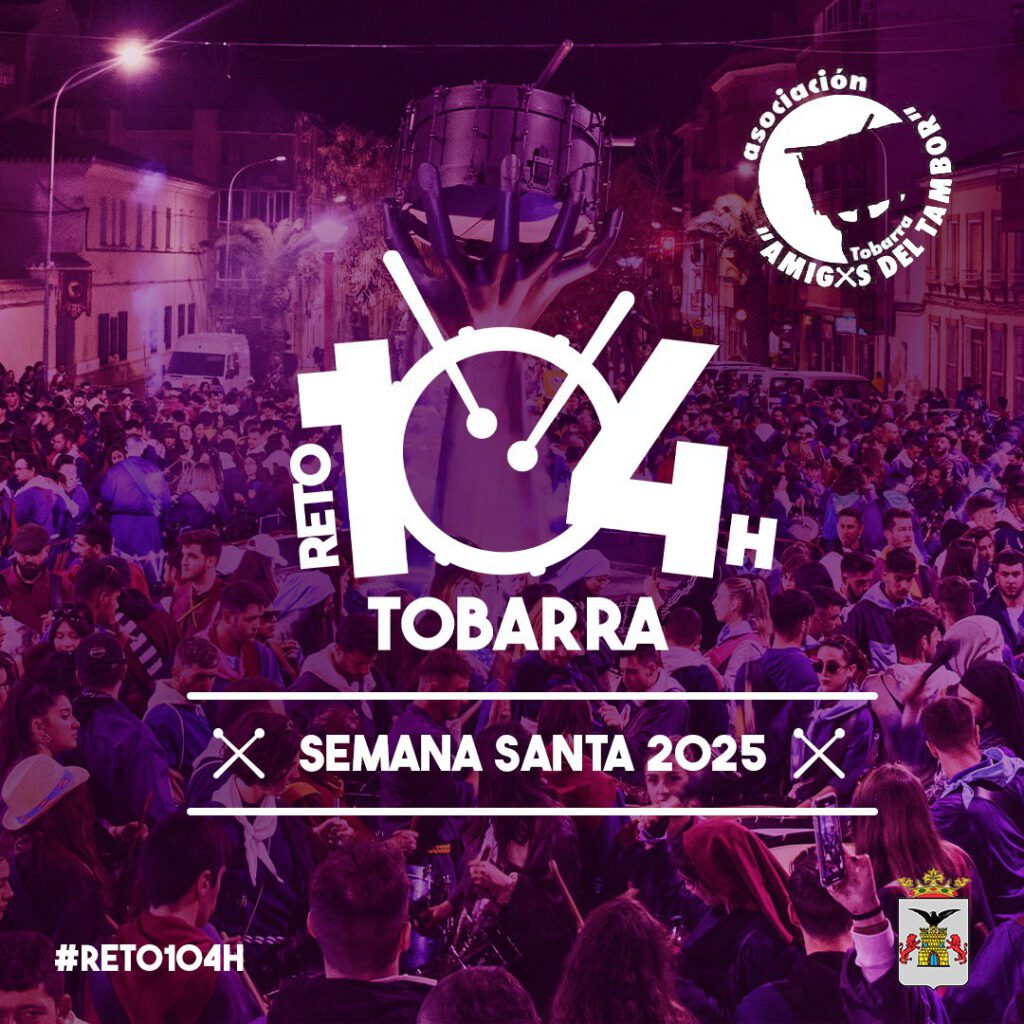
The 104 Hours Challenge aims to highlight and promote the drum culture and this unique tradition for tourism within the framework of all the national drumming events. It is about the 104 hours of uninterrupted drumming that take place in the municipality during Easter Week.
The event will focus on our most distinctive tradition, the 104 hours of drumming. The event will consist of placing a fixed drum on a lectern on a stage where it will be played by more than 400 drummers, with the aim of overcoming the challenge of completing the 104 hours on a single drum in a cooperative way. In order to successfully complete the challenge, the fixed drum will have to be played uninterruptedly from Holy Wednesday at 16:00h until Easter Sunday at 00:00h.
General Objective:
To promote and promote the drumming culture for tourism, highlighting the tourism potential of the Tobarra Drumming Festival, which has been declared a “Cultural and Intangible Heritage of Humanity” by UNESCO.
Specific Objectives:
- Increase tourist interest in the locality.
- To promote the tradition of drumming in Tobarra, its traditional drumming and its craftsmanship in the manufacture of drums.
- Generate a greater economic impact on the locality during Easter Week.
- Promote the tradition of the tamborada among all the people of Tobarre.
- Promote citizen participation around a cultural activity of a cooperative nature.
- Strengthen intergenerational and family ties through a collaborative community event.
- To promote, publicise and consolidate the “Tobarra” brand as the cradle of the Drum in the national and regional media.
Historical and cultural framework
The TAMBORADA DE TOBARRA and its importance as cultural heritage:
Easter Week in Tobarra is one of the most important cultural events in the province of Albacete and one of the most important anthropological manifestations at regional and national level, recognised by the Government of Spain and the Regional Government of Castilla-La Mancha.
In Tobarra during Holy Week, one of the most spectacular drumming events in Spain and the world takes place. 104 hours of uninterrupted duration that begin on Holy Wednesday at 16:00h, and end at 24:00h on Easter Sunday, being the longest in Spain and making it unique in the world.
Historical recognition and media coverage:
On numerous occasions, the 104 hours of Tobarra have had a wide repercussion in the media, appearing on several occasions in television programmes and large national channels such as Tve, Antena 3, La Sexta and Telecinco have echoed the extraordinary nature of this drumming tradition during Holy Week, even featuring in several chapters of the famous series Cuéntame como pasó on RTVE. .
In addition to the media interest in the uniqueness of this tradition, Tobarra has made the news on numerous occasions for refusing to change the time during the “summer time change” that occurs in Spain. This change usually takes place in March and sometimes coincides with Easter.
This insurgence to the time change is supported unanimously by the whole population with the aim of completing our traditional 104h. This situation has attracted the attention of both international and national media. The latter flooded the streets of the village to tell the news. Television crews and the main radio stations travelled to the municipality to do their reports, interviews and live connections.
In 2018 came an international recognition that multiplied the media interest and the cultural value of all the tamboradas in Spain, including that of Tobarra. The recognition of Intangible Heritage of Humanity, granted by UNESCO, put the Drum in the spotlight, recognised its cultural interest and shielded this centuries-old tradition shared by numerous towns in Spain.
In 2016, the head of Education, Culture and Sports of the JCCM Ángel Felpeto announced to the media the declaration of the Tobarra tamborada as an Asset of Cultural Interest (BIC) in the category of Intangible Asset, quoting in a press conference “With this measure, the registration and documentation of the celebration is guaranteed, as well as the safeguarding of its values”.”
A people with pride in their traditions.
The timetable for drumming in Tobarra during Holy Week, as set out in the different municipal ordinances, changed, always depending on the procession, from 1906 (when only a few hours were allowed to be played), until 1976, when the current timetable of 104 hours of uninterrupted drumming (from 16.00h on Holy Wednesday until 24.00h on Easter Sunday) was achieved.
If we ask any Tobarrese about something to be proud of in Tobarra, surely the 104 hours would come to mind, but “more said than done”.”. Although the timetable allows uninterrupted drumming at any time, it is difficult to quantify if throughout all these hours, at least one drum is playing in the streets of Tobarra. The challenge is to certify that this year at least one drum was playing during the entire 104 hours.
Rationale for Challenge 104h
That said, we are not trying with this work to reaffirm an icon of our tamborada, such as the hours of drumming, but rather to fulfil our main task as an association. To promote the drum and its craftsmanship in all its fields. And it is for this reason that the uniqueness of having 104 hours of uninterrupted drumming has led us to set ourselves the challenge of having a single drum playing during those hours uninterruptedly.
Undoubtedly, with this initiative we intend to take the tobarreño drum to the top. We are aware of the complexity of this, but at the same time, we are convinced of the media repercussion and the impact on tourism that overcoming the challenge would have. We would make our 104 hours known worldwide, we would leave a record of the feat, we would provide a legacy for our town worthy of mention, and of course we would capture in our museum of the drum (unique in the world) with an obituary, the protagonists who made this possible, both participants and creators.
Methodology and phases of the event
Structure of the 104 Hour Challenge:
The main idea comes from the Friends of the Drum Association, which will be carried out with the help of all the artisans for the creation of the drum and some sticks. These artisans belong to the people of Tobarreño with the aim of joining forces and creating a unique piece of Tobarreño craftsmanship.
The project will consist of two phases:
Firstly, to create a drum and sticks where all the artisans contribute their grain of sand to create an exclusive piece for the heritage of Tobarreño.
Secondly, that the drum can be played for 104 uninterrupted hours from Holy Wednesday to Easter Sunday. Obviously, the 104 hours will not be played by one person at a time, therefore, we will establish a period of subscriptions so that anyone from Tobarre who wants to play the drum can let us know. Depending on the number of participants we will establish the times and schedules that will allow us to cover the 104 hours. The recording and streaming of the challenge will allow us to present our candidacy for a possible Guinness Record.
Description of the Challenge Activity
Participants: Around 400 people will take it in turns to keep the drum beating uninterruptedly.
Location: “Monumento del Tambor” (Drum Monument) Avenida Constitución. An emblematic space in Tobarra, with easy access for residents and tourists.
Calendar: From Holy Wednesday 16 April to Easter Sunday 20 April 2025.
Shift management: The management of the shifts and their organisation will be carried out by the members of the association, organising the shifts and ensuring the prior preparation of the participants.
Logistics and communication details:
- Fixed drum stand to be placed on a stage.
- Technical support to ensure the production of the event
- A technical production team will be responsible for staging, technical production, sound, lighting or Stage Manager functions.
- The essential permits will be requested from the municipal authorities in order to ensure that the event can take place.
- Coordination staff and organisers of participants' shifts.
- A private security company will be contracted to guarantee security and the correct development of the challenge.
- Communications team to give visibility to the event in the months leading up to and during the event
- Live communication and streaming of the event during the 104 hours of the event.
The Drum of the 104h Challenge:
The Challenge drum will be a unique piece made by local artisans. Here are some of the unique features that the 104h Challenge drum will have:
- The drum will be made by professional craftsmen from Tobarre.
- The drum will be fixed at a central point in Tobarra, with no possibility of movement.
- The drum shall have two skins for simultaneous playing during changes.
- The drum will be elevated and on a stand, covered with advertising of the artisans, the name and timetable of all the people involved in the project.
- There will be video recordings while the drum is being assembled, to make a promotional video of the drum (sticks, skins, drum...).
- The drum will finally be exhibited in the drum museum, with all the utensils used and the names of the people who have used it, the drum beats, as well as their times and the material used.
Participants “Drummers:
One of the most important parts for the realisation of this challenge are the participants, the drummers who together will try to overcome the challenge.
- Ideally, there should be 416 people to play fifteen minutes per person without repeating any of them over the course of the 104 hours.
- There will always be a person from the Friends of the Drum Association or a person in charge imposed by them, who will have the power to leave or not to take the baton to someone who is not in a position to do so.
- The drummer whose turn it is to participate must be in optimum condition and must always be supervised by a member of the association or an accredited person in charge.
- The person taking part must be present forty-five minutes beforehand.
- The changes shall be made in such a way that the drum does not stop beating for a second.
- Participants should be prepared in case of unforeseen changes of schedule or any other setbacks.
The impact of the project
The Challenge will have a guaranteed media impact, both on the inhabitants of Tobarra, as well as on its immediate circle, surrounding towns and villages with a tradition of “semanasantera”. The challenge will become news and its impact will be positive for strengthening the "Tobarra" brand, for its local economy and for the consolidation of this unique tradition.
CULTURAL: Strengthening of the local tradition and the national and international projection of the tamboradas as a cultural manifestation of national tourist interest and, since the recognition of UNESCO, also international.
TOURISM: Opportunity to highlight the value of UNESCO's recognition of the tamboradas, to boost tourism in the town and increase the flow of visitors during Easter Week. The 104h Challenge meets all the requirements to become news, an opportunity to increase our tourist impact through the repercussion in the media.
ECONOMIC: The 104h Challenge aims to generate an economic and beneficial impact for local commerce, mainly for the catering sector. This event will not only generate an economic impact added to that generated by Easter, but it is also an opportunity to increase the value of the tourist brand “Tobarra. Cradle of the Drum”.
The challenge will become news and its repercussion in the media will have a very high “Publicity” value and will generate an impact impossible to achieve through advertising or sponsored spaces.
SOCIAL: This challenge will be an intergenerational event, for all audiences and of a collaborative nature. The aim is to encourage citizen participation in a community event that celebrates our most particular tradition. The 104h Challenge aims to generate local pride and an activity that unites us as a community to overcome the challenge.
AWARDS AND RECORDS: Once the Challenge is achieved, we could explore the candidacy for records or other recognitions such as the Guinness World Records.
The current Guinness World Record for the longest drumming session stands at 200 hours, achieved by Adewale Adeniran, a drummer from Nigeria, in 2024. This feat was accomplished by playing the African talking drum for several consecutive days, adhering to strict Guinness rules that include cumulative 5-minute breaks for each hour of activity.
Earlier, other records stood out as equally impressive. For example, Joseph Adu-Peprah from Ghana reached 162 hours and 5 minutes in April 2024, beating the previous record of 150 hours set in 2023.
The Guinness World Record for the largest number of people playing the same instrument simultaneously was achieved in several musical categories. Some notable examples include:
PianoIn 2023, 25 people played the same piano simultaneously in Nicosia, Cyprus. The event was organised by Stavros Kyriakides and several local institutions, dividing the musicians to play in different registers of the instrument (high, medium and low).
Theremin: A remarkable record involved 272 people playing the theremin in Japan, a unique instrument that does not require direct physical contact.
Communication, Promotion and Media Planning
In order to guarantee the success of this event, not only must we take into account the essential technical details for its execution, but we will also have a Communication Plan that will guarantee the communication and dissemination of the event in the months prior to its celebration.
To do so, we will have to take into account the different media and digital platforms available to us. We will have a budget for advertising investment to publicise the event, reach key audiences and get the message of our campaigns across to the event's potential audiences.
SOCIAL NETWORKS: Social Media Planning and Community Manager for the event. Regular digital communication with content to reach our audiences and potential audiences.
PRESS: Writing press releases for the main digital newspapers and national and regional newspapers. The press releases will allow us to have a presence in the media for free “Publicity”.
DIGITAL ADVERTISING ON META (Facebook Ads): Meta's promoted ads platform allows us to structure a sustained advertising campaign over time. Campaigns with specific communication objectives, which provide us with metrics with which to measure the effectiveness of the advertisement and allow us to narrow down our target audiences very well.
TRADITIONAL MEDIA: Appearance in traditional media such as radio, inserts in local, provincial and regional newspapers. Presence on local and regional television through interviews or reports.
OUTDOOR ADVERTISING: Campaigns in traditional media such as billboards, outdoor advertising and different PLVs such as roll-ups, advertising canvases or flyers that support the communication of our campaigns.
MERCHANDISING: The merchandising of the event will allow us to cover a double function, that of giving visibility to our event and that of being able to monetise them in order to raise funds for the realisation of the event.
Target Audience and Potential Audiences
In terms of communication it is vitally important to know who we are targeting with our campaigns. Our target audience profile is divided into two main groups, one being the more than 200 participants who will take part in the event and the other being the general public, i.e. the spectators.
In this section we will define our audiences in order to be able to create an audience profile to target in both traditional and local media.
Target Audience “TAMBORILEROS PARTICIPANTS”:
This target audience will be mainly Tobarreños and Tobarreñas with a real passion for drumming. These participants do not necessarily have to live in Tobarra, but have a strong enough link with our tamborada to commit to playing in a collective project.
Although there will of course be exceptions, our profile of participants will be between 18 and 90 years of age.
THE "CUADRILLAS TAMBORILERAS" AS A SOCIAL PHENOMENON.
The "cuadrillas tamborileras" are the backbone of the associative fabric around which the drum is played, and we must take them into account as collectives where we can find our potential participants. Being able to attract family members and members of these groups is essential to ensure the attendance of an audience that will accompany the participant at all times.
Target Audience “TOURISTS or SPECTATORS”:
The other large group is made up of the audience or potential attendees of the event. There is a large number of tourists who in one way or another have participated or have visited us at Easter and they are the ones who will accompany the “cuadrillas” and will form the majority of the audience at the "104h Challenge".
RELATED MUNICIPALITIES AND IN THE SURROUNDING AREA.
We can detect other potential audiences in some localities that are very similar to our municipality and that share family roots or close ties with the people of Tobarre, such as Elda, Petrer, Alicante, Valencia, Barcelona and other key municipalities to which our ancestors had to migrate at some point. We can detect where our tourists come from and focus our resources on bringing them to the event through advertising on social networks.
We imagine this public profile as a person between 18 and 80 years old with a past linked in some way to the Tobarra tamboradas, who has already visited us on other occasions or who simply likes to visit the different cultural manifestations of Easter Week in our region.
At this point we must bear in mind that the people who are most fond of drumming are the drummers from other towns who have a deep-rooted tradition in their respective towns. That is why we must take this opportunity to let them know about our event, as the continuous nature of the event (104h uninterrupted) will allow us to have an opportunity for other drummers to come with their drums to enjoy the event.
SWOT ANALYSIS OF THE EVENT
The following is a SWOT analysis of the event where the main threats, weaknesses, strengths and opportunities of the event can be visualised.
WEAKNESSESCostly to organise, high technical production costs, extremely long event, complicated logistics, large number of participants.
THREATS: Adverse weather conditions, lack of participants, streaming audiovisual production, technical problems, failure of the Challenge for any reason.
STRENGTHS: Attractive and novel event, Drummers and attendees enthusiastic about the challenge, Guaranteed influx of public, News event and very viral, Tamboradas recognised as a UNESCO intangible asset, Tamborada highly valued in surrounding municipalities.
OPPORTUNITIESTo increase the cultural value of the tamborada in Tobarra, To add value to the declaration of the tamboradas as an Intangible Asset, Opportunity to appear in the national media, The Challenge will become news, the magnitude of the event will open the doors to sponsors or sponsors.